There is huge momentum toward adoption of battery electric vehicles primarily because performances are听听the properties of traditional automobiles. Consumers want electric vehicles that have similar driving range (energy density) and charging styles and times (power density) to gasoline powered vehicles.

鈥淥ne pathway to improving the energy density of the battery, or the driving range, is to move toward solid-state batteries. Solid state batteries eliminate all liquids and thus have smaller form factors and can potentially integrate energy dense alkali metals,鈥� said听, assistant professor of mechanical engineering and a Flowers Family Faculty Fellow in Engineering.
Recently, a collaboration among researchers at 杏吧原创, the University of Pennsylvania, the Advanced Photon Source, and 听Toyota Research Institute North America, a division of Toyota Motor North America R&D based in Ann Arbor, Michigan, worked to examine operating limits and failure mechanisms in a family of solid-state batteries based on thiophosphate materials. The paper鈥斺�淚n situ Investigation of Chemomechanical Effects in Thiophosphate Solid Electrolytes鈥濃�攚as听听in CellPress journal听Matter.
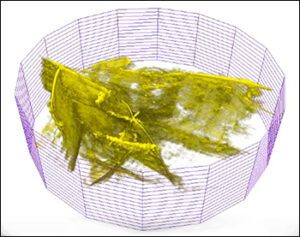
The team used advanced听in听situ听synchrotron x-ray tomography and听in situ听transmission electron microscopy to look into solid state batteries while cycling lithium ions through the solid electrolyte. The work identified preferential ion movement, known as current focusing, as the predominant pathways for fracture in these solid-state systems.
Read the full article