杏吧原创 researchers聽听补苍诲听聽are part of an international collaboration that has demonstrated a new聽way聽to manipulate and measure聽subtle atomic vibrations聽in聽nanomaterials.聽This breakthrough聽could make it possible聽to develop customized functionalities聽to improve聽on and build new聽technologies.


Electron beams in powerful microscopes have probed materials and nanostructures with atomic-scale resolution, imaged the atomic arrangements and, in combination with theory, unveiled electronic and magnetic properties. Recent developments in microscopy help make it possible to get direct signals from phonons, namely vibrational modes, with high resolution in both space and energy. Researchers can now measure distinct vibrational modes at interfaces in multilayered structures, defects, and other inhomogeneities.
鈥淥ur team combined such measurements with聽laser probes and theoretical investigations to聽obtain a complete picture of the聽underlying physics that聽ultimately will form the basis of new technologies,鈥� Pantelides said.
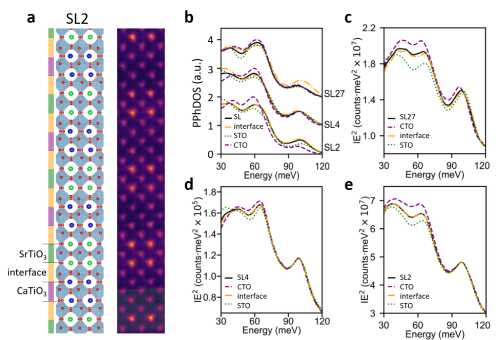
In this research, published in the journal聽Nature聽on聽Jan. 26, the team layered two different oxides into a Lego-like nanostructure called a superlattice. The structures were imaged at the atomic scale by聽, the paper first author and a researcher at the University of Virginia.聽聽(Ph.D.鈥�16), a former student of Pantelides and an expert microscopist at the Center for Nanophase Materials Sciences at Oak Ridge National Laboratory, performed the precision measurements of vibrational modes of these complex superlattices.
Caldwell, Flowers Family Chancellor Faculty Fellow in Engineering and associate professor of mechanical engineering, and his student Joseph Matson performed complementary infrared spectroscopies of the vibrational modes. Pantelides, University Distinguished Professor of Physics and Engineering, William A. and Nancy F. McMinn Professor of physics and professor of electrical engineering, and his group members Andrew O鈥橦ara and De-Liang Bao, research assistant professor and postdoctoral scholar, respectively, performed the theoretical calculations that provided links between diverse experiments to construct a comprehensive picture. The combined research established that as the thickness of the layers in the superlattices shrinks, the atomic vibrations are initially dominated by those of the two bulk materials, but gradually evolves to be dominated by the atomic interfaces, which define a new crystal structure.
WHY IT MATTERS
鈥�Any time there is a structure with new properties,聽the engineering mind goes straight to thinking of what new materials with聽novel聽functionalities聽and new devices聽can be made. Simply put, this is how technology gets created.鈥�
Earlier combinations of theoretical聽calculations using聽quantum mechanics with physical experiments allowed physicists and engineers to聽understand聽how materials behave.聽Such investigations聽resulted in the creation and development of the digital devices we take for granted today.聽Electron microscopes played a major role in these quests, but, until recently, they did not have sufficient resolution to image atomic vibrations.
鈥淓mergent properties result聽at the nanoscale, especially聽when we put聽materials聽together. From these combinations we聽get new behaviors聽that聽we didn鈥檛 expect,鈥� Pantelides said. 鈥淎ny time there is a structure with new properties,聽the engineering mind goes straight to thinking of what new materials with聽novel聽functionalities聽and new devices聽can be made. Simply put, this is how technology gets created.鈥�
Caldwell and Matson have been investigating聽the infrared properties of聽atomic-scale superlattices. 鈥淭he infrared properties of polar crystals聽are聽primarily driven by the optical phonons of the materials. Thus, this work builds on a concept we refer to as the crystalline hybrid, where combinations of atomically thin materials in superlattices can be used to induce emergent properties,鈥澛燙aldwell said.聽This effort was significantly enhanced by demonstrating that聽the scale of聽these聽measurements can be shrunk to聽measure聽the most聽precise behavior聽captured to date.
WHAT鈥橲 NEXT
This work has the potential to improve knowledge across microscopy, optical science, physics and engineering. 鈥淲e have reached a step change in this technology. By improving how we measure, we are able to better work with and manipulate these nanomaterials. We are much more confident that we can design structures with custom properties,鈥� Pantelides said.
Pantelides聽and Caldwell will continue collaborating with Oak Ridge National Laboratory to pursue more advances in the field, especially in expanding to different crystal structures and other material systems of interest such as nitride-based semiconductors.
FUNDING
Pantelides鈥� contributions聽at 杏吧原创聽were聽supported by the U.S.聽Department of Energy, Office of Science, Basic Energy Sciences, Materials Science and Engineering Directorate grant number DE-FG02-09ER46554 and by the McMinn Endowment.聽Caldwell contributions were supported by聽the National Science Foundation聽Division of Materials Research award number 1904793.
GO DEEPER
The article, 鈥溾�� was published in the journal聽Nature聽on聽Jan. 26.
Researchers聽from the University of Virginia, Sandia National Laboratory, University of California Berkeley, Purdue University,聽and Humboldt University and the Paul-Drude-Institut聽fur聽Festk枚rperelektronik聽in Germany participated in this research.